OUR BCI presents participant-led recommendations for ethical implanted brain-computer interface research. Developed through the BCI Pioneers Coalition’s collaboration with academic researchers, the recommendations draw on lived experience to guide how trials are designed, conducted, communicated, and concluded.
The document covers 13 areas, from access to trial information and informed consent to compensation, brain data privacy, and post-trial care. It is offered as a first step toward a code of practice and will evolve as additional perspectives are included.
Version 1.0 · November 10, 2026
Acknowledgements
This document was developed through collaboration between members of the BCI Pioneers Coalition with academic researchers as part of a Canadian Social Sciences and Humanities Research Council (SSHRC) Partnership Engage Grant (#892-2023-1099) entitled OUR BCI: Outlining user-defined goals for responsible innovation in implanted brain-computer interface technologies.
The recommendations were developed through a series of facilitated Zoom discussions held between October 2025 and October 2026 with members of the BCI Pioneers Coalition, a digital forum led by people with lived experience participating in implanted BCI trials. The project was developed by BCI Pioneers Coalition founder Ian Burkhart in collaboration with professors Amanda van Beinum and Jennifer Chandler. The recommendations reflect the lived-experience judgments and priorities of the participating Pioneers, while the research team led and supported the process through which those views were elicited, organized, synthesized, and drafted. The participant contributors provide the central experiential and normative authority for the recommendations. The research team and a core group of participants contributed to drafting, revising, and finalizing these recommendations.
Research Facilitators:
Amanda van Beinum, Assistant Professor, Sociology, York University
Jennifer Chandler, Professor, Canada Research Chair (Tier 1) in the Law and Ethics of Brain Technologies, Common Law, University of Ottawa
BCI Pioneer Leads:
Ian Burkhart, Founder, BCI Pioneers Coalition
Galen Buckwalter
Scott Imbrie
Buz Chmielewski
We are grateful to the participants who took the time to join our online workshops and contribute their perspectives to this project.
Finally, we would like to thank Iman Kashif for providing research support.
Purpose & Scope
The needs and priorities of people who participate in implanted brain-computer interface (iBCI) research may differ from those emphasized by researchers, sponsors, manufacturers, institutions, and governance bodies without comparable lived experience. This statement offers participant-led recommendations for how iBCI trials can be designed, conducted, communicated, and concluded in ways that better reflect the experiences, interests, and concerns of participants.
These recommendations are intended for investigators, research staff, sponsors, manufacturers, funders, institutions, research ethics boards, regulators, and others responsible for iBCI research. They are offered as a first step toward development of a code of practice for iBCI research. We encourage the community to work toward the adoption of a binding code of practice that can ensure effective oversight by IRBs, research funders, and regulators, and ensure consistency and transparency for participants, researchers, and industry sponsors. Meanwhile, where possible, research teams and institutions should translate relevant recommendations into documented plans, responsibilities, timelines, funding commitments, and participant-facing procedures.
We recognize that all participants and all iBCI trials are different, and other perspectives and issues related to iBCI research continue to emerge. We present these recommendations as an responsible guide to inform the design of future initiatives and studies.
We have outlined recommendations within 13 categories, organized loosely in a chronological order, as follows:
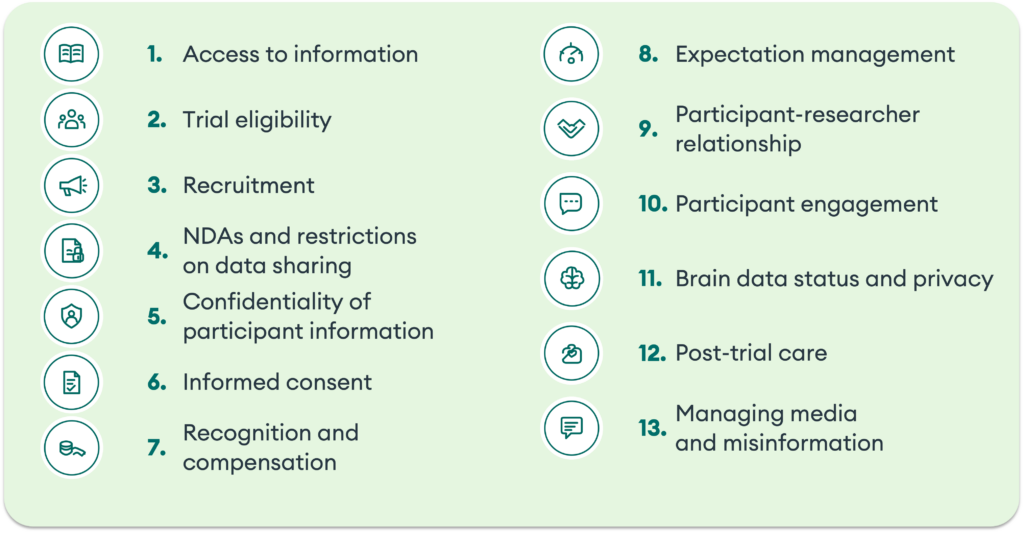
Specific recommendations for researchers and research teams, as well as an explanation and justification, are presented within each category.
1. ACCESS TO INFORMATION ABOUT THE TRIAL
Make information about trials more broadly accessible. This could be done through targeted advertisements (e.g. in rehabilitation centers), information made available through physical & occupational therapists and frequently updated research-focused websites and registries of clinical trials.
Help prospective participants evaluate trial quality. The BCI community should provide information to potential users about how to assess trial credibility, institutional responsibility, surgical and clinical support, financial protections, data practices, and post-trial plans. This would help to avoid risks to participants from enrolling in high-risk trials.
Provide access to peer support. Prospective participants should be given contact information for peer groups and advocates (e.g., BCI Pioneers, iBCI Collaborative Community, etc.). This facilitates peer-support, opportunities to ask questions, and more informed decision-making.
Participation is the choice of potential candidates, and healthcare professionals should not withhold information about trials. Healthcare professionals working with potential candidates for iBCI trials are sometimes reluctant to pass along information. They should be encouraged to view participation as the choice of the candidate, and as offering important benefits for the right candidates.
A healthcare provider passing along information about a trial should not be understood as a recommendation to participate. Reluctance to pass along information about trials could perhaps be addressed if this is understood not to be a recommendation to participate.
2. TRIAL ELIGIBILITY
Reasonable flexibility about eligibility criteria increases access. While medical eligibility criteria are important for participant safety, ethical research, and scientific purposes, it is important that these do not unnecessarily impede inclusion of candidates wishing to contribute to research.
Eligibility should be discussed with interested participants, rather than making presumptions. Presumptions about a participant’s particular condition can be wrong, and eligibility should be assessed in conversation with participants known to want to participate in research, rather than through pre-screening.
There should be reciprocal compatibility between participant and researchers. In addition to medical eligibility criteria, it is important to ensure that participants and researchers can work well together, given the demanding and long-term nature of implanted BCI trials and the close collaboration between researchers and the participant.
3. RECRUITMENT
| LIVED EXPERIENCE “I wish I could have spoken with someone who had been through a trial before. A fellow participant could have helped me understand the day-to-day experience in a way that clinical explanations alone could not.” |
Use clear, brief, accessible recruitment information. Recruitment materials should explain the purpose of the study, major burdens, approximate timelines, uncertainty of benefit, likelihood of access to a commercial device, and the distinction between research and clinical treatment.
Recognize scientific contribution and purpose as legitimate motivations. Many participants value curiosity, purpose, and the opportunity to advance science.
Be explicit about therapeutic prospects. Recruitment should be clear about whether therapeutic benefits or access to a working device are expected, and under what conditions. It is important to make sure participants understand that participation in the trial may not produce therapeutic benefits for them personally or necessarily offer ongoing access to a working device during or after the trial.
Recruitment materials should emphasize the importance of continued rehabilitation efforts. Sometimes a participant’s unfounded expectations about BCIs may undermine motivation to continue with rehabilitation efforts. Participants should be encouraged to maintain full efforts at rehabilitation alongside trial participation.
Participants should be made aware of alternatives to study participation. For example, they could be offered consultation with a therapist about other available assistive devices should they choose not to participate.
4. NON-DISCLOSURE AGREEMENTS (NDAs) AND RESTRICTIONS ON DATA SHARING
Participants should be free to discuss their experiences in the trial, subject to limited exceptions. Participants should never be restricted from discussing matters relevant to their safety and rights as research participants. There may be reasonable restrictions on the details of specific research objectives or experiments (e.g. national security/defense, commercial competition and intellectual property protection, academic confidentiality prior to publication etc.).
If there is an NDA, it should be reasonable and precise in scope, clearly drafted, and negotiated prior to consent to participate.
Create a non-waivable safety-and-rights exception. No NDA, confidentiality term, embargo, or commercial agreement should prevent communication with healthcare providers, legal counsel, regulators, ethics bodies, safety monitors, family or support persons, or other appropriate channels concerning safety, rights, mistreatment, or suspected misconduct.
Participants should not be subject to penalties for inadvertent disclosure of information about the trial. This can be an undue source of anxiety and have a chilling effect on legitimate discussions.
Any restrictions on discussing matters related to the trial should be time limited. There should be a limited embargo on discussing details about the trial.
5. CONFIDENTIALITY OF PARTICIPANT INFORMATION
Resolve inconsistencies in approaches to confidentiality of participant information. Informed consent and research ethics obligations specify confidentiality obligations that are frequently superseded by university/hospital requests for participants to sign media releases. Research confidentiality commitments should be coordinated with university, hospital, sponsor, and media practices so participants are not simultaneously promised confidentiality and pressured to sign broad publicity releases.
Participants should be given the choice of including their names in research publications. Obscuring participant names in publications is undermined by sharing names, likenesses and other details in the media. If participants have made contributions at the level of co-authorship, they will also be named. Participants should be given the choice of whether they would like to be directly acknowledged in research publications given the implications for confidentiality.
The issue of confidentiality should be revisited during the course of the trial. Participants may become more comfortable with public attention as time goes on, and there may be benefits to being publicly known (e.g. consulting opportunities). Participants always have the option to share their experiences themselves, but should have the option to revisit with researchers the degree of confidentiality observed in publications, conferences, media coverage, etc. on a regular basis.
Acknowledge the relative impossibility of maintaining absolute privacy/confidentiality in some cases. Small patient populations and limited numbers of trials, alongside media attention, may make users identifiable in some cases. This should be discussed with the participant prior to the trial. Researchers may not be able to guarantee absolute privacy in some cases.
6. INFORMED CONSENT
| LIVED EXPERIENCE “All too often researchers seem to approach the consent process as a needless hurdle; a signature to be obtained to be able to get on to the good parts of the project. More realistically consent sits at the heart of participant trust. Inadequate consent is a fundamental breach in BCI research.” |
Treat consent as a supported process. Consent materials should minimize jargon, use accessible formats, allow sufficient time for questions, and support individualized communication. Measures needed to support informed decisions will vary according to the participants but could include: presence of supportive friends/family members, multiple meetings, questioning to verify the understanding of the participant.
Draw attention to consequences that may not be obvious. Some aspects of trial participation that participants may not anticipate include: timelines prior to implantation, possibilities of premature termination of the trial (e.g. loss of grant funding, movement of researchers, withdrawal by sponsor), possibilities of renewal or extension of the trial, handling of medical side effects or other problems (i.e. coverage of medical needs, compensation for injuries), reimbursement of costs and compensation for time, and responsibility for safety and integrity of the device.
Participants may be very excited about the research and may not be as attentive to their own interests as they could be. The informed consent process may be perceived as “take it or leave it” and participants should be encouraged to consider their own interests. They should be directed to BCI Pioneers Coalition or other prior participants for advice from peers with experience.
Due to the length of trials, there should be a plan for reviewing, updating and reconfirming consent. When there is a material change in the study protocol, consent forms should be updated and renegotiated. There should be a reasonable balance to avoid undue burden due to repeated consent processes. Possible material changes could include, among others: change in the study objectives, additional uses of data, length of contracts, and changes in number/length of research sessions.
| LIVED EXPERIENCE “I need time to ask questions and understand what participation will mean for me. Consent should be a conversation that continues as the study changes.” |
State research objectives with enough specificity for meaningful review. The description of the research objectives in the study protocol should be reasonably clear and specific. Blanket or general descriptions in research protocols allow for flexibility but make it harder for research ethics review and informed consent processes to be fully informed. If there is a new research question or method, then it should be considered by the review board and consent reconfirmed with the participant.
Provide a practical, nonpunitive right to leave. Consent forms should provide safeguards that allow participants to leave the trial for any reason, without impact on their medical care. The consent form should outline clear steps and timeline for device removal should participants decide to leave the trial. Consent forms should lay out possible scenarios in which participants end trial participation (e.g. keep a device to use, retain hardware in-situ, explantation, etc.)
Provide regular independent check-ins. Due to the length of most BCI trials, it would be advisable to have regular (perhaps annual) checkpoints to verify that the participant wishes to continue. This could be done by someone not affiliated with the research team to ensure participants are comfortable having candid discussions in the event of any problems.
Explain study logistics as accurately as possible. The timelines of key trial components, such as any delay between study consent and implant surgery and the possibility of intensive time commitments required should be made clear to participants at the outset. Participants should be made aware that all BCI trials are different, so that they do not unduly rely upon the experiences of prior trial participants.
Researchers should clarify expectations regarding media involvement. Involvement with the media should be based on participant choice rather than be an expected component of trial involvement.
Address decoder and experimental changes. When scientifically possible, participants should be informed in advance about task, decoder, or parameter changes that may affect perceived performance. When blinding is necessary, the possibility should be disclosed during consent and participants should be debriefed promptly after any changes to experimental tasks, decoders or parameters.
7. RECOGNITION AND COMPENSATION
Participants should not have to pay out of pocket for trial participation. Trial participation can require additional expenses for participants such as additional medical care, support services, and accessible travel. Costs of participation should be paid in advance by the research team where reasonable, to avoid hardship due to reimbursement delay. Participants should be reimbursed for any additional out of pocket expenses they incur. Any requirements for reimbursement (e.g. need for itemized receipts) or potentially ineligible costs should be made clear to participants in advance.
Participant time is valuable and should be compensated. Study participation involves a time commitment that extends beyond scheduled tasks in the lab (e.g. medical evaluations, travel time, psychological programs, etc.). The cost of living for someone with disabilities is high. Participants should be fairly compensated for their contributions beyond just reimbursement of costs, like travel or parking fees. Participation in events that bring attention to the research program or device manufacturer should be compensated. Trial participants must, at a minimum, receive adequate recognition of the time they contribute and their continued commitments to scientific advancement. Concerns about financial inducement to participate should not impede reasonable compensation for time and effort contributed.
Participant expertise and input is valuable and should be recognized. Trial participants are deeply engaged in the production of knowledge through contributing their time, efforts, bodies, experiences, and perspectives. Many consider themselves members of the research team and research advances cannot be made in their absence. Participants should be offered the opportunity to participate in and contribute their inputs to research team meetings and scientific publications. Their contributions to shaping the direction of research should also be acknowledged.
| LIVED EXPERIENCE “We are not just only a participant, but we’re also making the science actually happen” |
Credit intellectual and experiential contributions accurately. Participants develop considerable expertise in iBCI which they share in multiple forums (conferences, etc.). Participation in events that bring attention to the research program or device manufacturer should be compensated. Participants who make substantive intellectual contributions should have a genuine opportunity to participate in drafting, review, and approval of publication and presentation of research findings.
8. EXPECTATION MANAGEMENT
Acknowledge uncertainty as a central feature of iBCI research. Trials can involve trial-and-error on the engineering and on the participant side. This learning curve and the need to manage uncertainty should be acknowledged up-front as a central feature of trial participation rather than treated as an exception. Acknowledgement of uncertainty may be particularly important surrounding aspects of the trial involving haptic feedback and sensation, which can be highly anticipated.
Use continuing consent to manage expectations. Researchers should take time to ensure that participants understand what is written in study agreements. This may require multiple meetings and potentially evaluations of whether participants are understanding and retaining the content.
Communicate changes that may affect perceived proficiency. Sudden changes to tasks or decoder parameters can be frustrating for participants investing in developing proficiency with the iBCI. Where possible, participants should be informed in advance or debriefed afterward if these changes will be made.
Clarify ownership and control of the device before implantation. Consent and study agreements should identify who holds legal title to implanted components, external hardware, accessories, software, access credentials, participant-specific decoders, and replacement components. Formal ownership should be distinguished from possession, bodily authority, practical control, maintenance responsibility, and rights of continued use. An institute’s, sponsor’s, or manufacturer’s property interest should not by itself determine whether an implanted component is removed, deactivated, materially altered, or made unusable.
Additional studies. Maximum scientific benefit should be drawn from participants’ implantation. Consideration should be given at the outset to whether a participant can enroll in an additional study if there are delays between implantation and the start of the experiments, or if the participants are able to devote time to multiple studies without undermining or impeding the results of the initial study.
9. PARTICIPANT-RESEARCHER RELATIONSHIP
Participants should be offered roles as part of the research team. Based on participants’ interest and availability, roles such as advisor, partner, and co-researcher are appropriate. Inclusion in the team helps participants to feel valued and motivated in the trial and improves the quality of the research.
Acknowledge the range and evolution of research relationships. Long-term collaboration can produce meaningful interpersonal relationships despite differences in background or worldview. These relationships should be respected without obscuring professional responsibilities or participant protections.
Create conditions for candid communication. Active engagement of participants is vital for trial success. Participants need to know they can ask questions and express concerns despite any communication barriers and gaps in expertise.
Recognize and mitigate power asymmetries. Recruitment, consent, and retention can be one-sided, with researchers holding the power to dictate the content of agreements. Scientific advancement and participant respect/comfort/agency/benefit may at times be at odds. Though official agreements exist to outline participant rights, participants may still feel pressured to remain in a study knowing that their contributions of data are needed for researcher objectives and career progression. All parties should be aware of these power dynamics and seek to acknowledge and actively mitigate them where necessary.
Participant-centered research is the best model to strive for as the field moves forward. Researchers should endeavor to include participants on the study team at the design stage and, where possible, to integrate activities which are enjoyable and/or directly beneficial for participants.
10. PARTICIPANT ENGAGEMENT
Recognize purpose and meaning. Many people join iBCI trials out of a sense of curiosity and wanting to make a scientific contribution to the future of therapy and assistive devices for spinal cord injury and other conditions where iBCI may be useful. Participants contribute significant time and effort, and many also find trial participation deeply rewarding and meaningful.
| LIVED EXPERIENCE “I’m very involved in saying how things should happen with the study, and they’ve changed a lot of things based on my input.” |
Offer opportunities for scientific engagement. Most trial participants are personally invested in furthering the science of iBCI development. Participants should be given the choice to have meaningful opportunities to be involved effectively in trial design and management, such as through solicitation of feedback and engagement in team meetings.
Include enjoyable or directly useful activities when compatible with the science. Long-term participation is demanding. Where feasible, studies should incorporate tasks or interactions that are engaging or beneficial to participants without compromising the research objectives.
11. BRAIN DATA STATUS & PRIVACY
| LIVED EXPERIENCE “To have a seat at the table in how the data is going to be handled, and if it’s going to be disclosed.” |
Brain data should be understood as the participant’s personal information, with researchers as stewards of this information. The data collected from participants is valuable scientifically and may be used to develop intellectual property, but it is also the participant’s personal information. Participants consent to the collection, use and disclosure of this data by researchers, but they retain a right of access to their own data. Any restrictions on participants’ use of their own data should be clearly specified during the consent process and should be reasonable. Research institutions should function as stewards of the brain data and develop transparent processes through which this data is protected and stored, and through which access to this data is granted. An outline of the processes through which data is stored and protected should be made available for participants. Requests for additional access to and use of data beyond the initial consent and study agreement should be approved by participants. Participants should be given the opportunity to consent to upload their data to open-source repositories, given the challenges with maintaining anonymity of that data. Claims of data ownership should be made explicitly clear and the concept of brain data ownership should be considered through ongoing conversations.
Participants should have a say in how their data will be managed and disclosed. Participants understand the need for collection and sharing of this data in order to advance iBCI science. However, they want to be informed about where their data is going and what it is being used for.
Participants should have a choice of whether to be named in publications. As pioneers pushing forward the science, some trial participants may want to be named and associated with their published data, while others wish to remain anonymous. This choice should be extended to participants.
12. POST-TRIAL CARE
Research involving iBCIs should include a commitment for device updates and maintenance post-trial for a reasonable time period. Where a device is providing benefits that a participant wishes to keep, they should be entitled to ongoing support for its use. It is recognized that an open-ended commitment is ideal but may be difficult to achieve. Research funders should set aside resources to support ongoing use of the device for a reasonable time period after the conclusion of the trial.
Involve participants in choices about post-trial care. The end of a trial can be significant for participants, and they should be given as much notice as possible, including regular reminders as this point gets closer. Participants should be given time to decide on and prepare for explantation surgery. Contingency plans should be in place in case of issues with the device and/or with explantation surgery – responsibility for participant well-being does not end with removal of the device.
| LIVED EXPERIENCE “What happens when things go wrong? What happens at the end of the trial? How can we best support participants so they have choice and autonomy about how the trial ends?” |
Keep beneficial use open during premature trial termination or transition. The possibility for continued device use should be kept open and explored with participants.
Secure funds for maintenance and explantation. Researchers should explore the possibility of setting up an escrow fund for costs of device removal to permit participant choice in timing and location of explantation. The amount of funds should account for the possibilities of unforeseen issues arising from explantation. Criteria for release of the escrow funds, including the period of time they will be held for, should be clearly outlined in advance and communicated to the participant.
Address investigator and institutional mobility. Study teams should have a plan in place to address whether/how participants can follow researchers if the trial is moved to another institution. Issues to address include assumption of responsibilities to the participant with respect to device support and maintenance and provision of funds for explantation. If transfer is not possible, arrangements described above for a reasonable time for continuing support and maintenance should be honored.
Design and advocate for guaranteed baseline functionality. Looking to future clinical deployment, researchers and manufacturers should aim to develop technologies that are able to maintain basic functionality for as long as possible, and that are robust against commercial discontinuation. Obtaining repeat brain surgery is not feasible – implanted devices and related software must retain a basic level of functionality over time. Design choices and regulatory policy should mitigate the risks of obsolescence of the hardware and abandonment of legacy software since these devices become part of people’s bodies and lives.
13. MANAGING MEDIA & MISINFORMATION
Insist that media portray information about spinal cord injuries and other neurological disorders, BCIs, and BCI trials as accurately as possible. This is important for managing public expectations, including the expectations of potential future iBCI trial participants.
Limits and future development: a living BCI Pioneers statement
This statement reflects the deliberation of 6 members of the BCI Pioneers Coalition who participated as part of the OUR BCI Project. Their direct experience gives the recommendations distinctive value, but the group is small and cannot represent the full diversity of people who may consider or use implanted BCIs. As a result, this is a “living document” rather than a final or universal account of participant priorities. Future versions will change as perspectives are added that differ by diagnosis, disability, communication method, device type, trial duration, degree of experienced benefit, age, gender, race, culture, geography, healthcare system, socioeconomic circumstances, privacy preferences, and experience of adverse events, withdrawal, explantation, or trial termination.
These recommendations will be regularly updated by a small rotating BCI Pioneers working group responsible for coordinating review, gathering feedback, and bringing proposed changes back to the Coalition for approval using an approved process.
The BCI Pioneers Coalition working group plans to review this document every 24 months and to solicit ongoing input and feedback through their website: https://bcipioneers.org/
People with lived experience of iBCI trial participation are invited to reach out and participate in the review and revisions process. Please contact the Pioneers at info@bcipioneers.org.
Issues Pending Discussion at Next Revision
This is the first version of this document. There are no pending issues at this time.
Prior Versions
There are no prior published versions at this time.